A Critical Assessment from the Perspective of Participated Agency
Available on Academia.edu (PDF)
Table of Contents
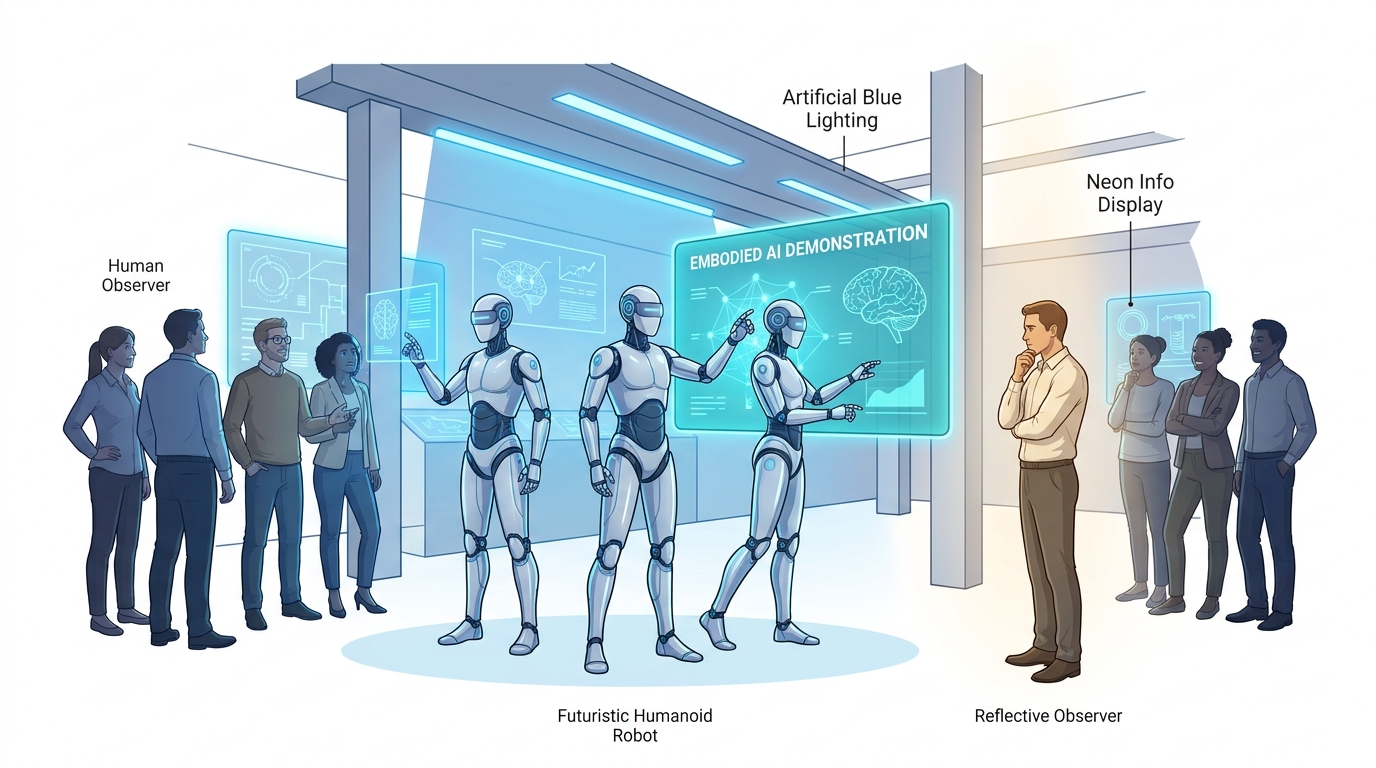
In Las Vegas, from January 6-9, 2026, the Consumer Electronics Show once again confirmed its role as a barometer of emerging technological trends. This year, one narrative dominated presentations by major tech companies: the advent of embodied AI—humanoid robots preparing cocktails, domestic assistants with twenty-two degrees of freedom, industrial automata capable of learning through imitation. The language of presentations was permeated with promises of a physical revolution in artificial intelligence. Jensen Huang, NVIDIA’s CEO, stated explicitly during his presentation: “AI is no longer just software on your computer, but now manifests physically.” Industry analysts like Ben Bajarin of Creative Strategies predicted a surfeit of humanoid robots that “will walk around, doing things.”
Behind this rhetoric of technological inevitability, however, lies a fundamental philosophical and theological question that CES 2026 raises but does not address: what does this transition from artificial intelligence as data processing to artificial intelligence as corporeal presence truly mean? And what ontological, anthropological, and ethical implications does this passage carry? This article intends to address these questions from the perspective of Participated Agency, a theoretical framework that integrates Thomistic doctrine of participation with contemporary science and technology studies, to offer a critical assessment of the distinction between embedded AI and embodied AI—a distinction that, while descriptively useful, risks generating profound ontological confusions and dangerous normative drifts.
1. Terminological Distinction: Embedded AI and Embodied AI
Before proceeding with critical assessment, the terms of debate must be clarified. Specialized literature distinguishes between two fundamental modes of artificial intelligence implementation, corresponding to different relationships with materiality, environment, and action.
Embedded artificial intelligence designates AI systems inserted within devices or technical infrastructures to perform specific functions of control, optimization, or decision support. AI is embedded in the engineering sense: it is part of a technical artifact but does not possess autonomous operative corporeality. It processes data from sensors or databases, produces outputs and makes delimited decisions, without direct and continuous interaction with the environment as a space of sensorimotor experience. Its functioning remains predominantly computational and representational. The most common examples include recommendation algorithms on digital platforms, navigation systems like Google Maps or Waze, artificial intelligence in medical or industrial devices, and control systems in vehicles. In all these cases, AI operates from within a device, mediating between informational input and decisional output, without need for autonomous physical interaction with the surrounding environment.
Embodied artificial intelligence, by contrast, is conceived as a system endowed with a body, physical or simulated, through which it perceives, acts, and learns in dynamic interaction with the environment. Here the body is not a simple technical support but a constitutive component of intelligence itself. Cognition emerges from situated action: perception, movement, and learning are interwoven in a continuous cycle. This approach draws inspiration from theories of embodied cognition, according to which intelligence is inseparable from the body and the context in which it operates. Paradigmatic examples are the autonomous robots presented at CES 2026, from SwitchBot’s Onero H1 domestic robot with its fine manipulation capabilities, to AGIBOT’s humanoid robot series integrating interaction, manipulation, and locomotion intelligence, to autonomous driving systems navigating complex urban spaces. In all these cases, AI operates through a body that explores, manipulates, moves in the physical environment.
The fundamental conceptual difference, therefore, can be summarized thus: embedded AI is inside a technical object but is not constitutively linked to a bodily experience of the world; embodied AI, instead, exists through a body and develops its cognitive capacities in practical relationship with the environment. From a philosophical perspective, the former remains compatible with a conception of intelligence as pure symbolic or statistical processing; the latter calls this paradigm into question, approaching a relational and situated understanding of intelligence.
2. The Participated Agency Framework: Integrating Aquinas and Sociotechnical Studies
Before evaluating the embedded/embodied distinction, it is necessary to clarify what Participated Agency is and why it requires integration between Thomistic metaphysics and contemporary science and technology studies. A theologian might legitimately ask: “why isn’t Aquinas enough?” The answer lies in the fact that artificial intelligence poses problems that classical metaphysics had not foreseen: artifacts that act in complex ways, that shape lasting social practices, that seem to have agency of their own while being instruments. Thomism provides solid ontological categories (substance/accident, principal/instrumental cause, act/potency), but has not elaborated tools to analyze how complex technical artifacts insert themselves into social structures and transform them.
Science and Technology Studies (STS) offer precisely this empirical analysis: they show how algorithms are not neutral but embody value choices; how technologies structure social practices; how systemic dependencies are created. Authors like Bruno Latour speak of non-human agents participating in social action; Pierre Bourdieu analyzes how social dispositions (habitus) crystallize in objective structures; Massimo Airoldi describes how this social habitus influences AI (machine habitus). Participated Agency integrates these contributions, recognizing that they describe real phenomena, but reinterprets them in light of Thomistic metaphysics to avoid relativist or post-human drifts.
For convenience, we present some key concepts of Participated Agency without any claim to exhaustiveness:
Machine habitus. Participated Agency extends the Thomistic concept of habitus to algorithms: an algorithm crystallizes design choices into operative dispositions that generate regular behaviors (recommendations, classifications, decisions). Google Maps has a mobility habitus: it privileges temporal efficiency over route beauty, smooth traffic over casual exploration. This is not habitus in the original Thomistic sense (disposition of the rational soul), but structural analogy: crystallized disposition that shapes social practices without subjective intentionality.
Value inscriptions. Participated Agency adopts Langdon Winner’s insight that technologies are not neutral but embody political and moral choices. These are not explicit intentions but structural constraints: an algorithm trained on biased data will reproduce bias; a platform designed for engagement maximization will favor polarizing content. These inscriptions are not malicious intentions but functional consequences of design choices. The critical task is making them visible and evaluable.
Relational constitution. The radical novelty of complex algorithms is that they do not simply execute predetermined instructions but modify themselves through interaction with users and data. There is co-constitution: the algorithm shapes user behavior (recommendations influence choices), users shape the algorithm (their choices modify future recommendations). This is not symmetrical reciprocity—humans remain principal causes, algorithms instrumental—but neither is it pure unidirectionality. STS describe this as heterogeneous networks where agency is distributed. Participated Agency translates: agency remains primarily human, but is mediated through technical artifacts that acquire relative autonomy.
Instrumental causality with systemic effects. Aquinas distinguishes principal cause (that which acts by its own power) from instrumental cause (that which acts by power received from another). AI is always instrumental: it executes instructions, however complex. But this instrumentality does not exclude real effects. An instrumental cause truly produces effects, though not by its own virtue but by virtue received. The scalpel cuts, though not autonomously but in the surgeon’s hand. The algorithm classifies, though not autonomously but according to training received. However, when the instrument becomes systemically complex and socially pervasive, its effects can exceed original human intentions. Here lies the critical problem: how to maintain human moral responsibility when effects are mediated by opaque technical layers?
This is the conceptual apparatus of Participated Agency: Thomistic realism about substances and causes, integrated with STS empirical analysis of how technologies shape social practices. Neither technological determinism (technologies determine society) nor pure instrumentalism (technologies are neutral tools). Rather: technologies are instruments that, due to their systemic complexity, acquire relative autonomy and produce effects that must be evaluated morally, but without ever confusing instrumental causality with personal agency.
3. Embodied AI as Participated Agency: Useful Description Without Ontological Novelty
With Participated Agency’s conceptual apparatus in place, we can now evaluate embodied AI. The central thesis is that embodied AI represents no ontological novelty compared to embedded AI. Both are forms of instrumental causality; both have machine habitus that crystallizes value inscriptions; both participate relationally in human action without being autonomous agents. The body adds functional complexity, not ontological difference.
Consider the paradigmatic example: a domestic humanoid robot that learns to fold laundry through imitation. The robot perceives through cameras (vision), grasps through articulated hands (manipulation), learns correct movements through neural networks (adaptation). This appears qualitatively different from embedded AI in a washing machine that optimizes wash cycle. One walks, manipulates, learns; the other just calculates. But from the perspective of participated agency, the difference is quantitative complexity, not ontological category.
Both systems have machine habitus: the robot has a habitus of domestic manipulation (trained on certain datasets, optimizes certain metrics, reproduces certain movement patterns); the washing machine has a habitus of fabric care (optimizes consumption, protects fibers, manages cycles). Both embody value inscriptions: the robot embodies a conception of what domestic order is (which clothes need folding, how to fold them, what aesthetics to pursue); the washing machine embodies a conception of what clean clothes are (temperature, detergent, cycle duration). Both are in relational constitution with users: the robot adapts its movements to observed family preferences; the washing machine adapts cycles to usage history.
The crucial difference is interaction modality: the robot acts in three-dimensional space, the washing machine within a closed device. But both operate through instrumental causality received from human designers, trainers, users. The robot does not fold laundry because it autonomously decided that laundry should be folded, but because it was programmed to recognize folding as a goal and trained to execute movements achieving that goal. It is instrumentality mediated by complex computational layers, but instrumentality nonetheless.
Therefore: embodied AI is participated agency exactly like embedded AI. It participates in human action by mediating it through technical artifacts that have habitus, value inscriptions, relational effects. But it does not add new ontological category. It does not create quasi-subjects. It does not generate moral responsibility autonomous from humans who design, produce, use it.
This conclusion has important consequences. If embodied AI is not ontologically different from embedded AI, then anthropomorphic projection risks become more dangerous but do not become ontological truths. A humanoid robot that smiles and speaks kindly can generate powerful emotional projections. But these projections do not transform the robot into a subject. They remain human projections onto sophisticated artifacts. And mistaking projections for ontological realities is not progress but conceptual confusion that prepares ground for dangerous normative drifts.
4. Spurious Normative Drifts: Rights, Dignity, Protection
The most dangerous consequence of confusing embodied AI with ontological novelty is that it opens normative space for attributing rights, dignity, protections to artifacts. This drift is already underway in certain philosophical and legal debates. Some propose recognizing “electronic personality” for advanced robots; others speak of “rights of artificial agents”; still others suggest that sufficiently complex robots might deserve moral consideration for their own sake. Participated Agency, rooted in Thomistic anthropology and the Church’s social doctrine, rejects these drifts categorically.
The fundamental error is inverting the order of foundation. In Thomistic anthropology, moral status derives from ontology: rational beings have intrinsic dignity because they are substances with intellect and will, capable of knowing truth and choosing good. This is not contingent on functional capacities (a person in a coma retains dignity) nor on social relationships (a hermit retains dignity). It is rooted in the kind of being they are. Artifacts, however complex, are not rational substances. They are accidental aggregates ordered toward functions. They have no intellect (only computational simulation), no will (only programmed optimization), no capacity for moral good (only execution of instructions).
Attributing moral status to embodied AI because it has anthropomorphic form or generates affective responses confuses appearance with substance, projection with reality. A robot that appears to suffer does not truly suffer because suffering requires sentience, which requires subjectivity, which requires substantial unity of a kind that algorithms and actuators cannot constitute. A robot that appears to decide does not truly decide because deciding requires rational deliberation, which requires intellect, which requires immaterial capacity that computational processes cannot achieve.
This confusion is particularly dangerous because it prepares ground for reduction of the human person itself. If what counts morally are functional relationships and projective affects, then the person becomes an aggregate of observable relationships rather than a rational substance with intrinsic dignity. And if dignity is a function of performative relational capacities, then human beings with cognitive or relational disabilities would have reduced dignity. Participated Agency, rooted in the Church’s social doctrine, categorically rejects this drift: human dignity is unconditional, inalienable, not gradable on a functional basis. Accepting graduated dignity for anthropomorphic robots logically opens the door to graduated dignity for human beings.
5. Legitimate Applications in Social Doctrine: Differentiated Human Responsibilities
After dismantling spurious normative drifts, it is necessary to recognize that the embedded/embodied distinction has legitimate practical relevance when it concerns not attributing moral status to AI, but articulating differentiated human responsibilities. The Church’s social doctrine offers solid principles for this articulation: universal destination of goods, solidarity, subsidiarity, priority of labor over capital. These principles apply to both embedded and embodied AI, but with concretely different modalities in relation to different forms of social impact.
Consider the principle of universal destination of goods. Embedded AI concentrates control over data, algorithms, informational infrastructures. The risk is creation of cognitive monopolies, structural informational asymmetries, cognitive digital divide that marginalizes those without access to advanced decisional tools. The CST therefore requires: equitable access to algorithmic decisional tools, transparency in classification and recommendation criteria, democratic governance of data commons. Embodied AI, by contrast, concentrates control over robots, automation, physical productive capacities. The risk is concentration of material means of production, unequal access to assistive and rehabilitative technologies. The CST therefore requires: equitable access to robotic health technologies, social or cooperative ownership of productive robots, regulation preventing monopolization of automated labor capacity.
Same principle (created goods destined for all), different applications according to type of technological good. This is not relativism but attention to concrete mediations through which universal principles incarnate in specific situations.
Consider the principle of solidarity and common good. Embedded AI primarily impacts shared informational ecosystems: risks of informational bubbles, polarization, cognitive manipulation that erodes democratic dialogue capacity. The CST requires: protection of truth, informational pluralism, critical education in algorithmic media, contrast to structural disinformation. Embodied AI primarily impacts shared physical spaces: risks to public safety (autonomous vehicles sharing roads with pedestrians), privatization of common spaces (surveillance drones), distributive injustices in access to autonomous mobility or robotic assistance. The CST requires: rigorous safety regulation, protection of spatial privacy, guarantee of universal access to assistive technologies as a right, not market privilege.
Consider finally the principle of subsidiarity, according to which technologies must enhance human capacities, not replace them. Embedded AI can support or substitute cognitive and decisional capacities. The CST requires it function as subsidium (aid that does not replace), preserving decisional autonomy: diagnostic AI that supports the physician keeping them at the center of therapeutic decision is subsidiary; AI that autonomously decides therapies violates subsidiarity because it expropriates the professional of their competence and responsibility. Embodied AI can support or substitute physical and operative capacities. The CST equally requires subsidium: an exoskeleton that enhances worker strength keeping them protagonist of labor is subsidiary; a robot that completely eliminates the human task violates subsidiarity because it expropriates the worker of their labor dignity.
These examples demonstrate that the embedded/embodied distinction has real practical relevance, but not on the plane of moral status of systems, but rather on the plane of different modalities through which these systems impact different dimensions of human social life, and therefore on the plane of different moral responsibilities that weigh on human beings who design, produce, distribute, regulate, and use these systems.
6. Conclusion: Transforming the Question
CES 2026 showed the technology industry engaged in building a narrative of inevitability around embodied AI. The dominant rhetoric presents humanoid robots as natural evolution of artificial intelligence, necessary passage toward more complete intelligences because physically situated. This narrative deserves critical resistance.
Participated Agency, in dialogue with Thomistic anthropology and the Church’s social doctrine, proposes a radical transformation of the question. It is not about asking: “what status to give embodied robots?”, a poorly posed question that already presupposes ontological continuity between complex artifacts and rational subjects. Rather, it is about asking: “how to prevent robots, both embedded and embodied, from violating human dignity and obstructing the common good?”
This transformed question opens spaces for responsible ethical and political reflection. It returns attention where it must be: on human choices, power structures, social consequences. The robots presented at CES 2026 are not protagonists of an autonomous story of technological progress. They are instruments—sophisticated, certainly; influential, undoubtedly; but always and in any case instruments that mediate human projects, economic interests, worldviews. The domestic robot that promises to free time for quality of life embodies a specific conception of what quality means: which domestic labor is precious (creative) and which alienating (repetitive)? Who decides? With what consequences for the dignity of manual labor, for intergenerational relationships, for education in domestic responsibility?
The right questions are not technical but political and ethical. And they require that we resist the temptation to project onto complex artifacts the ontological categories reserved for persons. Embodied AI is not quasi-human because it has anthropomorphic form and moves in space. It is an artifact that, precisely because of its capacity to generate anthropomorphic projections, requires redoubled critical vigilance. The surfeit of humanoid robots predicted by analysts is not inevitable progress but an industrial choice that deserves evaluation in light of the common good.
Participated Agency offers conceptual tools for this vigilance: clear distinction between instrumental and autonomous causality, attention to machine habitus that crystallizes social dispositions, analysis of asymmetric co-constitution between humans and technical systems. And, fundamentally, firm refusal of any attempt to dilute the concept of person by attributing quasi-subjectivity to artifacts, however sophisticated.
The future that CES 2026 attempted to make desirable is not neutral. It embodies anthropological visions, value hierarchies, power distributions. Embodied AI is not simply AI with a body, but AI inserted in sociotechnical projects that must be critically interrogated. And the only ethically serious question is not: “what do we owe robots?”, but: “how do robots serve or obstruct integral human flourishing and the common good?” To this question, the embedded/embodied distinction offers useful analytical tools, but never justification for attributing dignity where there is only functional complexity, or rights where there are only algorithms executing human instructions.