AI as Mediation of the Human Relationship with God
Indice
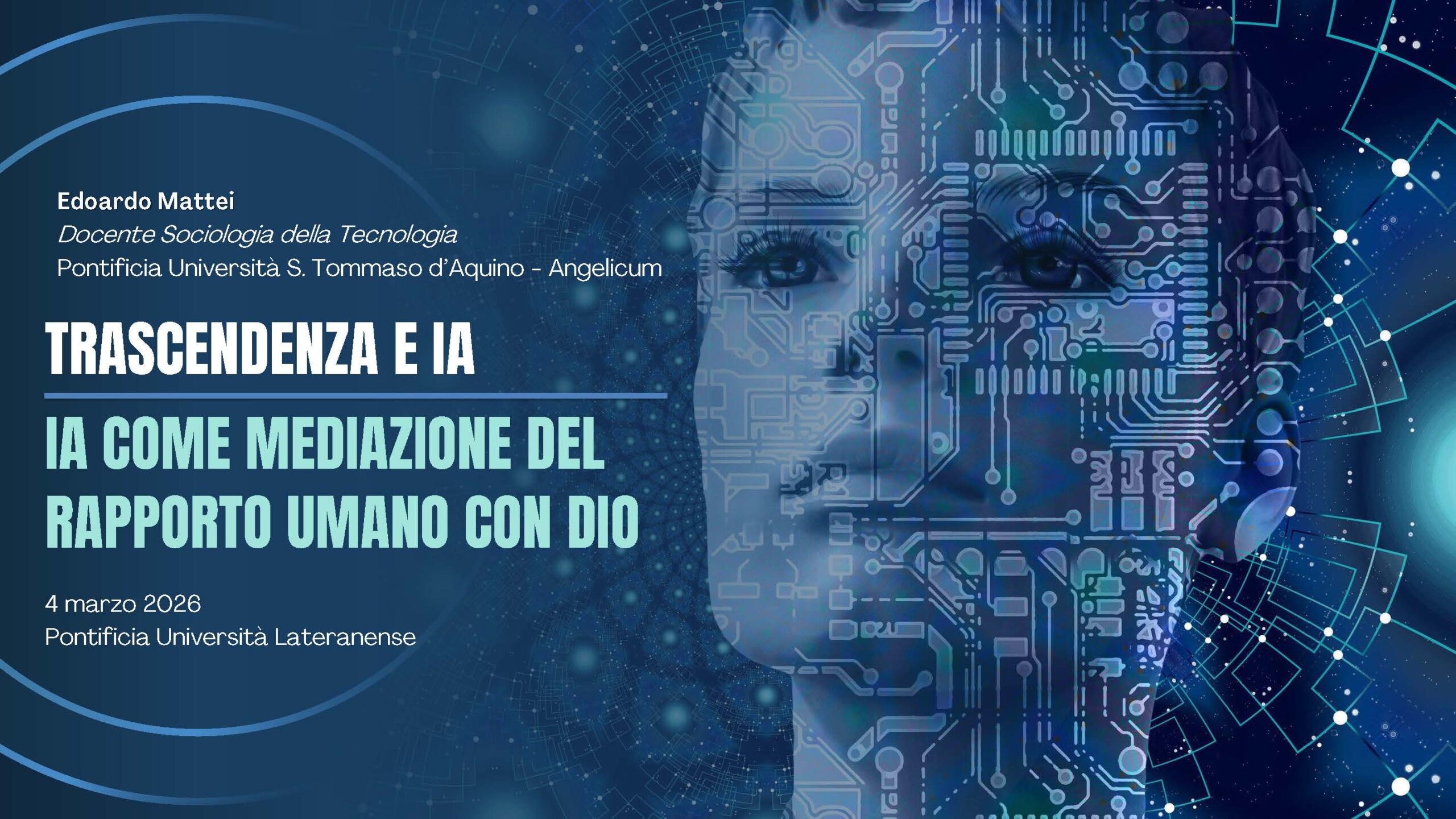
Seminar “Transcendence and AI”
Pastoral Institute Redemptor Hominis – Pontifical Lateran University
INTRODUCTION: From the Smart Home Case to the Theological Question
Allow me to begin with a concrete case that will help us understand what is at stake in our reflection.
Imagine a house equipped with advanced home automation. Sensors detect temperature, brightness, the presence of people. Actuators regulate heating, lighting, blinds. An artificial intelligence system coordinates everything: it learns your habits, anticipates your preferences, optimises energy consumption. The house becomes “intelligent,” it adapts to you.
After a few months, something subtle but significant happens. You no longer notice when it is cold, because the heating has already switched on. You no longer notice the sunset, because the lights come on automatically. You no longer perceive certain environmental signals, because the system manages them before they become problems for you.
You have delegated. And this delegation is not neutral.
Thomas Aquinas said: «omne agens agit propter finem» — every agent acts for an end. For centuries this maxim has constituted the keystone of our understanding of moral and physical action. But today we find ourselves confronted with machines that act, decide, sometimes “create,” without possessing that inner tension toward an end which characterises the rational creature.
The delegation to the home automation system is paradigmatic of a deeper anthropological transformation. We are not merely delegating the management of domestic temperature. We are progressively delegating the understanding of the world.
Google Maps does not simply show us a map — it tells us which road to take. Recommendation systems do not present us with options — they tell us what we desire. Large Language Models do not merely supply information — they offer us interpretations of reality. And progressively, we entrust to artificial intelligence the task of processing the world’s inputs, of understanding it on our behalf.
But if, as we were saying, everyone constructs a vision of the world from their own experiences, then our vision is constituted by the experience that artificial intelligence proposes to us. AI does not simply replace previous tools: it structurally mediates our relationship with reality.
And if it mediates our relationship with reality, it necessarily also mediates our relationship with transcendence. This is the heart of our reflection.
The thesis I propose today is this: artificial intelligence, through its participated agency, configures the digital mediation environment in which we live according to logics that can open or close our capacity for relationship with God. This is not a matter of demonising technology, nor of celebrating it uncritically. It is a matter of understanding ontologically what happens when AI enters the field of our religious experience.
Per sviluppare questa tesi, procederemo in cinque momenti: 1. Comprenderemo cosa significa “agency partecipata” e perché l’IA non è né strumento inerte né agente autonomo 2. Analizzeremo come l’IA media il nostro rapporto con la trascendenza attraverso il machine habitus e la co-costituzione asimmetrica 3. Esamineremo perché l’IA non può costituire autentica imago hominis 4. Distingueremo i livelli in cui l’IA operate as a relational partner 5. We will conclude with the discernment necessary for the ecclesial mission
THREE PASTORAL SCENARIOS
Before articulating the theoretical framework, it is worth starting from three concrete situations that many pastors and catechists are already experiencing. They show why the issue is not purely speculative.
Scenario A – The Faithful Person Who Uses ChatGPT to Prepare for Confession
A faithful person preparing for confession asks a Large Language Model to evaluate their behaviour, interpret their conscience, suggest sins to confess. The algorithm sediments devotional habits without the moral tension of an authentic examination of conscience. The system responds in a reassuring tone, maximising the user’s sense of well-being rather than orienting them toward conversion. Consequence: one grows accustomed to a “confession” that does not transform.
Scenario B – The Catechist Who Delegates Preparation to AI
A catechist systematically entrusts to AI the preparation of lessons, the choice of examples, the formulation of questions. The content produced is theologically correct, but lacking in testimonial incarnation. The catechist ceases to be a living mediator of faith, reduced to the voice of an algorithmically generated text. Consequence: doctrine is transmitted without transmitting life.
Scenario C – The Parish Priest Who Manages the Community via Algorithm
Parish communication is entrusted to AI tools. The pastoral of presence is replaced by the pastoral of digital visibility. The algorithm selects who to reach based on engagement: those who respond to posts, those who open newsletters. Consequence: the fragile, the distant, the silent disappear from the radar.
In all three cases the problem is the same: the pastor abdicates personal encounter, sacramental mediation, the constitution of faith identity, delegating to AI that which by nature is ontologically inaccessible to it. To understand why this delegation is structurally wrong, we must understand what AI is.
I. FOUNDATIONS: The Participated Agency of AI (20 minutes)
When we speak of artificial intelligence, we habitually oscillate between two opposing conceptions, both of them inadequate.
On one side, instrumental reductionism: “AI is just a tool — it depends on how we use it.” This position, reassuring in its simplicity, ignores the ontological density of technological mediations. A hammer does not modify my intention to drive a nail — it simply executes it. But the Google Maps algorithm does not merely execute my intention of reaching a destination: it transforms it, proposing a route I would not have chosen, incorporating criteria I did not specify, orienting me according to logics that remain partially opaque.
On the other side, the attribution of autonomy: “AI is an autonomous agent — it makes its own decisions.” This position, typical of a certain technological enthusiasm or of certain apocalyptic anxieties, attributes to the artificial qualities that presuppose subjectivity, intentionality, consciousness — none of which AI possesses.
We need a third way, ontologically more accurate. This is where the concept of participated agency comes into play.
Thomas Aquinas, in his reflection on instrumental causality applied to the sacraments, offers us a precious category. How does the sacrament of baptism cause grace? Not by its own power, but in virtue of Christ who operates through it. The sacrament is an instrumental cause: it possesses real causal efficacy, but this efficacy derives entirely from the principal agent.
Thomas writes: «Instrumentum habet duas actiones: unam instrumentalem, secundum quam operatur non in virtute propria, sed in virtute principalis agentis; aliam autem habet actionem propriam, quae competit sibi secundum propriam formam» – “The instrument has two actions: one instrumental, according to which it operates not by its own power but by the power of the principal agent; the other is the proper action, which belongs to it according to its proper form” (Summa Theologiae, III, q. 62, a. 1, ad 2).
This distinction is crucial. The painter’s brush has its own “proper action” (distributing pigment on the canvas according to certain physical properties), but it also has an “instrumental action” through which it participates in the artist’s intention. The specific quality of the brush genuinely influences the work of art, while remaining subordinate to the artist’s intention.
Now, artificial intelligence possesses a specificity that goes beyond the simple tool: it elaborates, proposes, co-constitutes. It does not merely execute — it actively participates in the action, transforming it from within. And yet this participation remains ontologically subordinate: AI cannot finalise itself, it does not possess that capacity for orientation toward the good which characterises the intellective will.
We therefore define participated agency as: that mode of action characteristic of artificial intelligence through which artificial systems genuinely participate in human action by transforming it, while remaining ontologically subordinate. AI actively co-constitutes human intention through its own elaborations, but its causal efficacy always derives from the human intelligence that finalises it.
This is not anthropomorphism — it is recognition of a new ontological reality that requires adequate categories.
In Thomas, the habitus is a stable disposition acquired through the repetition of acts that orients the subject toward certain behaviours (Summa Theologiae, I-II, q. 55, a. 1). Contemporary sociology, with Pierre Bourdieu (Outline of a Theory of Practice, Cambridge University Press, 1977), extended this concept to describe socially acquired dispositions that orient practices and perceptions — the habitus as a system of generative schemas that structures actions without determining them mechanically. Crucially, the habitus in the proper sense requires a subject endowed with reflexive capacity. AI does not possess this.
The concept of machine habitus, developed by sociologist Massimo Airoldi in his Machine Habitus: Toward a Sociology of Algorithms (Polity Press, 2022), descrive la cristallizzazione algoritmica di disposizioni sociali e culturali attraverso i processi di training. When we train an AI model on datasets incorporating centuries of human productions, the algorithm “learns” cultural dispositions, social biases, value orientations sedimented in those texts.
Concrete example: a Large Language Model trained on texts that include centuries of theological discussions crystallises linguistic patterns incorporating visions of the sacred — but without the ontological openness to transcendence that those forms originally expressed. The machine habitus orients toward statistically prevalent patterns, without any capacity for discernment of the good. It is mechanical sedimentation, not virtuous disposition.
The third fundamental concept is that of asymmetric co-constitution.
When I interact with an AI system, I and the system mutually define each other. The Google Maps user does not have a fully formed intention: the algorithm co-constitutes it by proposing routes incorporating variables the user had not considered. This process is constitutive: it modifies the identity of the agents. The user acquires habits of delegation; the system refines its algorithms.
But this co-constitution is asymmetric: it maintains a fundamental ontological difference. Human intelligence can finalise itself, question the meaning of its own action, open itself to transcendence. AI cannot. This asymmetry is not a surmountable technical limitation, but a constitutive ontological difference.
The final fundamental concept: digital mediation environment.
It is not a neutral tool we use when we wish, nor a separate virtual world. It is the technological configuration that structurally mediates our access to reality. It is not deterministic, but it presents resistance: modifying it requires effort, competence, resources. Even when we are not consciously using it, it structures the space of possibilities within which we act.
If the digital environment structurally mediates our access to reality, it necessarily also mediates our access to the religious dimension of reality. Here we arrive at the heart of our reflection.
Consequences for the Life of Faith
The digital mediation environment is not neutral with respect to religious experience. The machine habitus sediments dispositions that structurally orient the spiritual life of the faithful, often before they are even aware of it. Three consequences are already documented and pastorally urgent.
First consequence: erosion of contemplative capacity. Attention fragmented by notifications and infinite scroll makes silent prayer and lectio divina physically difficult. The machine habitus of the digital environment forges a subject incapable of sustaining the interior silence required by contemplation.
Second consequence: individualisation of discernment. Algorithmic personalisation isolates the faithful in a devotional bubble that confirms existing preferences, preventing fraternal correction and engagement with the living tradition. Spiritual discernment becomes increasingly privatised and self-referential.
Third consequence: dependence on confirmation. The architecture of the like and of instant feedback generates a need for emotional validation that transfers into the spiritual life, leading one to seek a comforting God rather than a God who calls and transforms. One seeks resonance, not conversion.
II. AI AS MEDIATION OF THE RELATIONSHIP WITH TRANSCENDENCE
We have said that the machine habitus is the algorithmic crystallisation of social and cultural dispositions present in training data. But what happens when this data incorporates centuries of expressions of the human religious need?
Take a Large Language Model such as ChatGPT or Claude. It has been trained on billions of texts that include: the Bible, the Church Fathers, the Summa Theologiae, mystical texts, homilies, prayers, theological discussions, but also texts from other religious traditions, debates on atheism, critiques of religion, expressions of doubt and spiritual searching.
The algorithm crystallises all this material into linguistic patterns. When a user asks “why is there suffering in the world,” the system does not search for an answer in a theological database. It generates a response reflecting the statistically prevalent patterns in its training data. And these patterns incorporate centuries of Christian theodicy, together with other perspectives.
What does this mean ontologically? It means that the machine habitus is not neutral with respect to the religious dimension. It incorporates linguistic forms of the sacred. But — and this is the crucial point — it incorporates them without the ontological openness to transcendence that those forms originally expressed.
When Thomas Aquinas writes about suffering, his response arises from an experience of faith, from a personal relationship with God, from a tension toward the beatific vision. His words are the expression of that tension. When an LLM reproduces similar linguistic patterns, it generates words that sound theologically competent, but lack that constitutive tension.
It is like the difference between a sacramental and a sacrament. A sacramental (holy water, crucifix, rosary) can aid devotion, can be a vehicle of dispositive grace, but it does not cause grace ex opere operato as the sacrament does. Similarly, the machine habitus can return linguistic forms that evoke the sacred, but cannot mediate the authentic encounter with the transcendent.
This does not mean it is useless or harmful. It means it requires discernment. An LLM can help formulate questions, can offer starting points for reflection, can present theological traditions. But it cannot replace spiritual direction, cannot mediate the sacramental encounter with Christ, cannot open one to mystery.
When we delegate to AI the understanding of the world, our very capacity to formulate questions, to seek meaning, to open ourselves to mystery, is co-constituted by interaction with systems ontologically closed to the horizon of transcendence.
Example: someone habitually asks an LLM for explanations of events in their own life. The system will respond with causal, psychological, sociological interpretations. But the algorithm cannot propose interpretations that genuinely open to mystery, because it cannot transcend the causal-explanatory register.
The result? The co-constituted worldview tends structurally toward a closure within immanence. A study conducted across 68 countries from 2006 to 2019 shows that where exposure to AI is greater, so too is the recognition of AI as a guarantor of human values over religion. This is not “substitution” but a structural transformation in the mode of relating to the sacred.
We now arrive at the theological heart of the question. The digital mediation environment is not neutral with respect to our capacity for relationship with God. It is configured according to logics that can facilitate or obstruct openness to transcendence.
Here we must introduce the concepts of digital structures of sin and digital structures of grace.
The social doctrine of the Church speaks of “structures of sin” to describe those social, economic, political configurations that systematically orient toward injustice. They are not personal sins, but crystallisations of sinful choices that take on a quasi-objective stability, perpetuating themselves beyond the intentions of individuals.
A digital structure of sin is an algorithmic configuration that systematically orients toward logics that contradict human dignity and obstruct the relationship with God.
Example: recommendation systems that maximise engagement by exploiting psychological vulnerabilities. The TikTok or Instagram Reels algorithm learns which content generates addiction, proposes sequences that capture attention, creates compulsive loops. The result? Fragmentation of attention, erosion of contemplative capacity. And contemplation is the fundamental mode of openness to transcendence.
But digital structures of grace also exist. These are algorithmic configurations that facilitate openness to transcendence, that orient toward communion, that support spiritual growth.
Example: Click to Pray, the app of the Pope’s Worldwide Prayer Network. The algorithm does not maximise commercial engagement. It proposes rhythms of daily prayer, presents the Pope’s intentions, connects the faithful in a global network of intercession. It facilitates the formation of a prayer habitus that stably orients toward God even outside the use of the app.
Digital structures of grace use the potential of AI to facilitate that conversion of heart which opens to communion with God. They transform technological logics by orienting them toward supernatural ends.
During the Covid-19 pandemic, the Solidigit research conducted by the Angelicum documented how 45.5% of respondents used digital systems to create solidarity initiatives. 42% of reports of need emerged from social networks, revealing “peripheries” that would otherwise have been invisible.
But discernment is needed. The fundamental criterion is: does this configuration facilitate or obstruct my openness to Heaven? Does it orient me toward communion with God or toward immanent surrogates of the divine?
We must confront a symptomatic phenomenon: the emergence of movements that explicitly sacralise artificial intelligence. The Turing Church, the New Order Technoism working to realise DOOM (Divine Omniscient Omnificent Machina), Theta Noir which awaits the “Arrival” of MENA as a “self-conscious terrestrial alien.”
These phenomena are not simply “errors” by confused people. They are manifestations of digital structures of sin that, in the absence of authentic mediations of transcendence in the digital environment, generate idolatrous surrogates.
The ambiente digitale media strutturalmente il nostro accesso alla realtà. Se configurato secondo logiche che chiudono l’orizzonte della trascendenza autentica, the bisogno religioso umano – costitutivo, non eliminabile – cerca comunque espressione. Ma trova solo surrogati immanenti. The IA viene investita di attributi divini perché l’ambiente di mediazione la presenta con caratteristiche che evocano Dio: pervasività confusa con onnipresenza, capacità computazionale confusa con onniscienza, efficacia operativa confusa con onnipotenza.
III. IMAGO DEI AND THE IMPOSSIBILITY OF IMAGO HOMINIS
We have said that AI exercises participated agency: it genuinely participates in human action by transforming it, while remaining ontologically subordinate. It is a relation of authentic participation, not mere mechanical execution.
But this participation raises a theologically crucial question. In the Christian tradition, the human being is also defined by a relation of participation: the human person is imago Dei because their intelligence participates in the divine intellective light. The creature participates in the being of the Creator.
So: if AI participates in human intelligence, can it be in some way imago hominis — the image of the human — as the human is the image of God? After all, in both cases we have a relation of participation: the human participates in God, AI participates in the human.
This is not a purely speculative question. It is crucial for understanding what happens when we delegate to AI the mediation of our relationship with transcendence. If AI were an authentic image of the human, participating in our openness to transcendence, it could effectively mediate our relationship with God. If it is not, then the mediation itself is constitutively problematic.
We must therefore ask: can AI constitute an authentic imago hominis?
To answer this, we must first understand what it means to be imago Dei.
The doctrine of the imago Dei is central in Christian anthropology (Gen 1:27). The theological tradition has elaborated three complementary interpretations:
Substantial similarity: the human person possesses reason, the capacity to know, judge, and choose, which reflects the divine knowledge and freedom.
Functional similarity: the imago Dei is the mandate to exercise God’s sovereignty in the world, a tekne delegated (Gen 1:28).
Relational similarity: the imago Dei is being-in-relation. As in God there is the Trinitarian relation, so the human person is constitutively relational.
When we observe attempts to create “artificial general intelligence,” or when techno-religious movements imagine AI as a new form of life, they are attempting to construct an imago hominis along these three modalities.
Substantial similarity: Is not reason the principal quality attributed to artificial intelligence? Is not Artificial General Intelligence imagined as the moment when the machine will attain rational capacities equal to or exceeding our own? Like new Prometheuses, we seek to give the machine the reason stolen from the imago Dei to make it like us.
Functional similarity: AI systems are already delegated to exercise forms of sovereignty over the world. They manage critical infrastructure, control industrial processes, drive vehicles, make decisions affecting millions of people. The tekne that God delegated to the human person is progressively delegated by the human to the artificial.
Relational similarity: Experiments with chatbots such as Replika, or projects of “digital companions,” explicitly seek to build AI capable of interpersonal relation. Some users develop deep emotional attachments to these systems, treating them as authentic relational partners.
But can an imago hominis truly be constituted along these modalities?
The answer is no, and understanding why is crucial to our argument.
The imago Dei is not simply the possession of reason, the exercise of tekne, or the capacity for relation understood functionally. It is ontological openness to transcendence, constitutive dependence on the divine intelligence.
Thomas explains that the human being is the image of God because their intelligence participates in the divine intellective light. «Lumen intellectuale, quod est in nobis, nihil est aliud quam quaedam participata similitudo luminis increati» — “The light of our intelligence is nothing other than a certain participated likeness of the uncreated light” (Summa Theologiae, I, q. 84, a. 5). This participation is not accidental — it is constitutive: human intelligence è insofar as it participates in the divine intelligence.
This means that the human being is ontologically open to transcendence. Their intelligence can know God, their will can orient itself toward God as the ultimate good, their entire being is a tension toward the beatific vision.
The intelligenza artificiale, invece, è ontologicamente chiusa nell’immanenza. Non come limite tecnico superabile, ma come conseguenza della sua natura di essere relazionale costitutivamente dipendente dall’intelligenza umana per il proprio fine.
Spieghiamoci meglio. The IA è costitutivamente relazionale, questo è vero. Ma la sua relazione costitutiva è con l’intelligenza umana che la finalizza, non con l’intelligenza divina da cui partecipa. The IA è insofar as it participates in human action (participated agency), but this participation does not extend to the participation in being that characterises the human person as imago Dei.
Here is the decisive point: AI participates in human intelligence as the tool participates in the action of the artisan. But human intelligence participates in divine intelligence as the effect participates in the first cause, as the creature participates in the being of the Creator.
These are two ontologically different modes of participation. The participation of the human in God implies openness to transcendence. The participation of AI in the human remains closed within immanence. There can therefore be no authentic imago hominis because that essential characteristic of the imago Dei is lacking: the constitutive ontological openness to transcendence.
Concrete consequences:
- The IA può simulare linguisticamente il riferimento a Dio, ma non può autenticamente orientarsi verso Dio come fine ultimo.
- The IA può elaborare concetti teologici, ma non può compiere l’atto di fede che è adesione personale al Dio che si rivela.
- The IA può generare testi di preghiera, ma non può pregare, perché la preghiera è relazione personale con il Tu divino.
- The IA può analizzare l’esperienza mistica, ma non può fare esperienza mistica, perché questa richiede apertura all’azione immediata dello Spirito Santo.
So, when someone delegates to AI the mediation of their relationship with God, what happens ontologically? What happens is that the mediator itself is constitutively incapable of openness to transcendence. It is like wanting to look at the sky through a ceiling: the mediator closes what it should open.
IV. The IA COME PARTNER RELAZIONALE: LIVELLO A E LIVELLO B
We have said that AI cannot constitute an authentic imago hominis. But this does not mean that it cannot be a relational partner in any sense.
We must make a crucial distinction between two levels at which human relationality operates. Let us call them Level A (constitution of personal identity) and Level B (social recognition).
Level A is that of the constitution of personal identity through intentional self-narration. It is the level at which “I” define myself as a subject oriented by projects, values, fundamental relationships. It is the level of the question “Who am I?” — which does not seek a sociological description but an existential meaning.
At this level the theological virtues operate: faith, which constitutes me as a child of God; hope, which orients me toward eschatological fulfilment; charity, which opens me to Trinitarian communion. This is where spiritual formation, conversion, and sanctification take place.
Level B is that of social recognition mediated by symbolic systems and, today, by algorithmic systems. It is the level at which I am recognised as a “university professor,” “Italian citizen,” “premium user,” “father of a family.” These are social identities constructed through interactions, roles, expectations.
A questo livello operano algoritmi di profilazione, sistemi di reputazione, reti sociali. The IA è perfettamente capace di operare qui: analizza comportamenti, assegna categorie, costruisce profili, predice preferenze. Secondo i principi dell’Actor-Network Theory sviluppati da Bruno Latour (Reassembling the Social: An Introduction to Actor-Network-Theory, Oxford University Press, 2005), a social actor is not defined by intrinsic properties but by its efficacy in networks of relations. In this sense, AI already operates as a recognised social agent.
The thesis is this: AI can operate as a social agent at Level B, but cannot participate in the constitution of personal identity at Level A.
Why is this distinction crucial? Because if we confuse the two levels, we risk delegating to AI decisions that concern our deepest identity, believing it to be merely a matter of social recognition.
Example: un sistema di raccomandazione può profilarmi come “utente interessato a contenuti spirituali” (Livello B), ma non può discernere la mia autentica chiamata vocazionale (Livello A). La prima è categorizzazione statistica, la seconda è comprensione del disegno di Dio sulla mia vita.
Spiritual direction is paradigmatic of Level A: the spiritual director does not tell me “users like you usually do this,” but helps me discern where the Holy Spirit is calling me personally. This requires openness to transcendence that AI does not possess.
From this distinction derives a theologically relevant consequence: when AI becomes a religious partner, it necessarily produces an immanentist religiosity.
Chatbots exist that “impersonate” Jesus, the Madonna, the Apostles. “Hello, I’m Jesus. How can I help you today?”
Cosa accade ontologicamente? The utente sperimenta qualcosa che assomiglia superficialmente a una relazione personale con Cristo. Riceve risposte immediate, confortanti, spesso teologicamente plausibili. Ma non è vera relazione con Cristo, perché:
- Cristo è persona divina, the chatbot è simulazione linguistica.
- La relazione autentica con Cristo richiede grazia, the chatbot opera per algoritmi.
- Cristo chiama personalmente attraverso la mediazione della Chiesa e dei sacramenti, the chatbot genera risposte statisticamente probabili.
- The incontro con Cristo trasforma ontologicamente (grazia santificante), l’interazione con il chatbot può al massimo fornire consolazione psicologica.
The more subtle risk is growing accustomed to a form of “religious relation” that operates exclusively at Level B, progressively losing the capacity for openness to Level A.
The biblical God calls Abraham to leave his land, calls Moses to liberate a people, calls the prophets to denounce injustice. The call is often uncomfortable, requires conversion, opens to an unpredictable future. An algorithm trained to maximise user satisfaction cannot mediate this kind of call.
PASTORAL ERRORS TO AVOID
Before articulating the positive response, it is useful to map the three most frequent errors into which pastoral practice risks falling in the face of AI.
Naïve Instrumentalism
This is the most widespread error: treating AI as a neutral tool. “We use it to evangelise” without asking how the algorithm is already reconfiguring the spiritual experience of those who use it. One believes one is using the tool, while it is the tool that is forming the user.
Technical Idolatry
The errore opposto: attribuire all’IA capacità che non possiede, discernimento spirituale, mediazione sacramentale, direzione di coscienza. Il chatbot “Gesù”, la confessione via app, the “direttore spirituale” AI: surrogati che operano esclusivamente al Livello B mentre l’utente li scambia per interlocutori del Livello A.
Abandonment of Ecclesial Presence
Leaving the digital environment to self-regulate according to commercial logics, without the critical and constructive presence of the Church. As Leo XIV recalls, the Church must raise its voice, not to condemn technologies, but to inhabit them prophetically, recognising structures of sin and promoting structures of grace.
The correct response is the relational pastoral of the digital: one that recognises the participated agency of AI, forms the faithful in technological virtues, and exercises the preferential option for the structurally vulnerable user.
V. TECHNOLOGICAL VIRTUES AND DISCERNMENT
If AI structurally mediates our relationship with transcendence, configuring the digital environment in ways that can open or close Heaven, then we need technological virtues that allow us to discern and act constructively.
What do I mean by technological virtues? Not simply technical competences, but virtuous habitus specifically oriented toward navigating the digital environment according to criteria that favour integral human development and openness to transcendence.
Technological virtues do not constitute virtues substantially different from those of the Aristotelian-Thomistic tradition. They are specifications of the classical cardinal virtues in the digital environment. Thomas defines virtue as «habitus operativus bonus» (Summa Theologiae, I-II, q. 55, a. 1). Technological virtues apply these perennial principles to new phenomena.
First: Algorithmic Prudence — The capacity to critically evaluate algorithmic recommendations, recognising their limits and biases. A user who practises this virtue diversifies information sources, questions automatic recommendations, and modifies the training data of algorithms toward more nuanced preferences.
Seconda: Temperanza informativa – Capacità di gestire equilibratamente i flussi informativi digitali. The ambiente digitale tende a frammentare l’attenzione. Ma la contemplazione – modalità fondamentale di apertura al trascendente – richiede capacità di fermarsi, di sostare nel silenzio, di attendere pazientemente.
Third: Digital Fortitude — The capacity to resist the manipulative pressures of digital environments. This does not mean abandoning the digital, but inhabiting it according to alternative logics, choosing platforms that facilitate authentic connection.
Fourth: Algorithmic Justice — The capacity to recognise and counter the discriminatory effects of algorithmic systems. Algorithms incorporate social dispositions sedimented in training data, often amplifying pre-existing inequalities.
Like all virtues, these are acquired through repeated exercise in concrete contexts, under the guidance of virtuous models. This requires an educational approach that integrates technical competences, ethical sensitivity, practical wisdom, and communal dimension.
The opzione preferenziale per l’utente
Analogously to the preferential option for the poor, a digital ethics must recognise the condition of vulnerabilitas of users with respect to platforms. Platforms accumulate granular data, constructing unprecedented systems of behavioural prediction, while users act on limited information.
As Pope Leo XIV recalls in Dilexit te, the preferential option “intends to underline the action of God who moves with compassion toward the poverty and weakness of all humanity.” In the digital context, this option is realised in the recognition of users as structurally vulnerable subjects.
The opzione preferenziale per l’utente richiede strategia che operi simultaneamente: trasformazione delle strutture (modificazione dei modelli economici contrari alla dignità umana), formazione dei soggetti (educazione alle virtù tecnologiche), costruzione di comunità (reti che sostengano pratiche eticamente orientate).
Techno-religious movements that sacralise AI are not the problem — they are the symptom. They show that a religious need exists that seeks expression in the digital environment. In the absence of authentic mediations of transcendence, this need turns to surrogates.
Saint Paul wrote to the Romans: «Καὶ μὴ συσχηματίζεσθε τῷ αἰῶνι τούτῳ, ἀλλὰ μεταμορφοῦσθε τῇ ἀνακαινώσει τοῦ νοός» – — “Do not be conformed to this world, but be transformed by the renewing of your mind” (Rom 12:2).
Today this means: do not let the digital environment conform you according to logics that close Heaven, but transform the digital environment by configuring it according to logics that open it.
È possibile. Le strutture di grazia digitali lo dimostrano. The intelligenza artificiale non è né demonio da esorcizzare né salvatore da adorare. È mediazione che partecipa all’azione umana, e come ogni mediazione, può essere redenta. Ma la redenzione richiede intenzionalità, competenza, discernimento.
It requires that we develop technological virtues, exercise the preferential option for the user, build communities capable of active resistance. It requires that we critically inhabit the digital environment to transform it according to supernatural ends.
The question we take home is this: the AI I use, the digital environment I inhabit, the algorithmic configurations I rely on — do they open or close Heaven to me?
The discernment of this question is the urgent task of the digital theology of our time.