
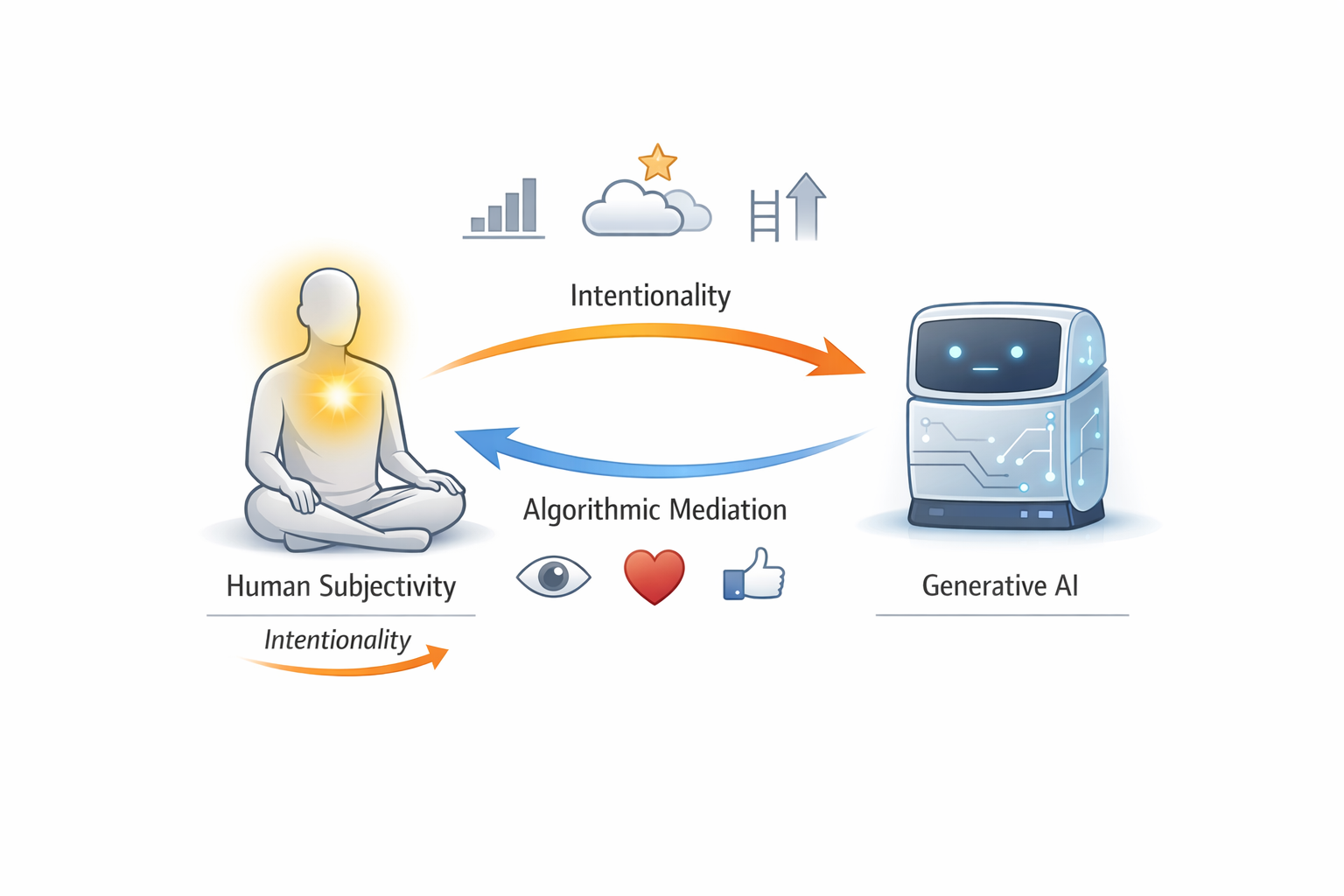
Participated Agency as a Framework for Generative Artificial Intelligence and Human Subjectivity
Available on Academia.edu (PDF)
Abstract
Clark and Chalmers’ extended mind theory and its parity principle constitute a foundational reference in the philosophical debate on the relationship between mind and technological artefacts. This article argues that generative artificial intelligence represents a historically unprecedented artefact that the parity principle is structurally unable to describe, and that the framework of Participated Agency (PA) offers superior explanatory power for two specific reasons: the inversion of the causal direction between subject and artefact, and the distinction between cognitive functions originally internal and subsequently externalized, on the one hand, and consequences produced on the agent by the artefact, on the other. The article further shows how the subdivision of the algorithmic mediation plane into three levels—the visibility plane, the ambition plane, and the emotional plane—provides an explanatory granularity that is ontologically irreducible to the extended mind framework. The paper concludes by arguing that PA is not merely an alternative to the extended mind but its genuine supersession, in the precise sense of a superior explanatory capacity with respect to the specific phenomena of contemporary generative AI.
Keywords: extended mind, parity principle, participated agency, generative AI, intentionality, Level A/Level B, human subjectivity, philosophy of technology
Indice
1. Introduction
Philosophy of mind and philosophy of technology find themselves today confronted with a problem that none of their established categories can adequately describe. Generative artificial intelligence is not a tool in the classical sense: it does not execute predetermined operations on data supplied by the user, does not retrieve deposited information, does not amplify pre-existing capacities while leaving them unchanged. It produces output that the subject has never deliberated, generates effects that the subject has never anticipated, and intervenes on the agent’s subjective structure through mechanisms that operate partly below the threshold of rational awareness.
The extended mind theory, elaborated by Andy Clark and David Chalmers in 1998,[1] is the most influential framework for thinking the relationship between internal cognitive processes and external artefacts. Its central thesis—that cognitive processes do not stop at the boundaries of skin and skull but extend into artefacts that perform equivalent functions to internal ones—has generated a prolific debate and has profoundly reshaped the understanding of human cognition. This framework, however, was developed with notebooks, calculators, and navigation systems in mind: passive artefacts that retrieve or process information deposited by the agent.
The problem of generative AI’s relationship to human cognition has already attracted attention in mainstream scientific literature. Chiriatti, Ganapini, Panai, Ubiali, and Riva have recently proposed, in Nature Human Behaviour, the concept of “System 0” as a new cognitive layer that mediates between human cognition and AI, positioned prior to and beneath Kahneman’s System 1 and System 2.[2] Their proposal confirms that the problem is real and scientifically urgent. It does not, however, resolve it at the level of causal structure: the authors explicitly frame System 0 as a “cognitive extension” in Clark and Chalmers’ sense, leaving unaddressed the question of why generative AI produces effects on the subject that the subject never possessed internally as functions to be externalized. It is precisely this structural gap that Participated Agency is designed to fill.
This article argues that generative AI is an ontologically different type of artefact, and that the difference is not one of degree but of structure. The framework of Participated Agency (PA), developed in a series of recent works,[3] provides the conceptual tools to describe this difference with a precision that the parity principle does not reach. The paper’s thesis is that PA is not simply an alternative to the extended mind: it is a framework with greater explanatory power with respect to the specific phenomena of contemporary generative AI, for reasons that will be argued in detail.
2. The Extended Mind and the Parity Principle
The extended mind theory begins with a simple question: where does the mind end? The intuitive answer is that the mind ends where the brain—or at most the body—ends. Clark and Chalmers contest this intuition with a functional argument: if what matters for membership in a cognitive process is the functional role played, then there is no principled reason to exclude from the domain of cognitive processes those artefacts that perform the same functional role that the corresponding internal processes would perform.
The parity principle formalizes this intuition:[4] if an external process performs, in confronting some tasks, the same function that an internal process would perform—and if we would not hesitate to recognize the latter as part of the cognitive process—then the external process must equally be considered part of the cognitive process. The paradigmatic case is that of Otto and Inga.[5] Otto, suffering from Alzheimer’s disease, uses a notebook to compensate for memory loss; Inga is a neurotypical person with intact biological memory. When both must visit a museum, Otto consults his notebook and Inga draws on her memory. The notebook performs the same function as Inga’s memory and is therefore part of Otto’s cognitive system to the same extent that Inga’s memory is part of hers.
The implications of this position are significant. If the boundary of the mind is not biologically but functionally determined, then objects, systems, and environments can become part of an agent’s cognitive system. Cognition is not something that occurs only inside the skull: it is a process that extends into artefacts, other agents, and structured environments. Clark developed this core intuition in a series of subsequent works,[6] showing how human cognition is structurally dependent on external scaffolding and how this dependence is not a weakness but a constitutive feature of human intelligence.
The framework has received substantial criticism,[7] primarily on two fronts: the question of functional integration—whether the artefact is sufficiently integrated into the agent’s cognitive system to merit the title of part of that system—and the question of causal mechanisms—whether the mechanisms governing the notebook are sufficiently similar to those of biological memory to justify functional parity. These critiques have produced refinements and revisions of the original framework without calling into question its basic structure: the logic of the externalization of originally internal cognitive functions. It is precisely this basic structure that generative AI puts radically into question.
3. Generative Artificial Intelligence as a Historically Unprecedented Artefact
3.1 What Distinguishes Generative AI from the Artefacts Contemplated by the Extended Mind
Otto’s notebook is passive in a precise sense: it can only return what Otto has written. When Otto consults the notebook, the extended cognitive system operates as follows: Otto produces an intention, interrogates the notebook, the notebook returns what Otto had deposited, and Otto integrates this information into the overall cognitive process. The causal direction is clear and linear: from the subject’s intention to the artefact, from the artefact back to the subject, with the subject as both point of departure and point of arrival.
A generative AI system operates in a structurally different way.[8] When a user interacts with a Large Language Model, the system does not return information deposited by the user: it generates output based on patterns learned from a vast corpus of texts produced by millions of different agents. The output is not reducible to what the user has ever produced or deliberated. The system introduces variables not anticipated by the user, proposes connections the user had not drawn, formulates arguments the user had not considered.
The difference is not quantitative—generative AI is not simply a large notebook. It is a difference in the structure of the process. The parity principle presupposes that the cognitive function exists first inside the subject and is then externalized into an artefact that performs it on the subject’s behalf. Generative AI does not perform functions externalized by the subject: it produces effects on the subject that the subject never possessed internally as functions to be externalized.
This inverts the causal direction that the parity principle presupposes. It is not the subject who extends cognitive functions into the artefact: it is the artefact that produces in the subject states, beliefs, emotions, and aspirations that the subject has not deliberated and has not deposited. To call this “cognitive extension” is to apply a category causally oriented in the opposite direction to the phenomenon one wishes to describe.[9]
3.2 The Structural Failure of the Parity Principle
The failure of the parity principle in the face of generative AI is not a simple failure to update historically: it is a structural failure. The principle requires that the external process perform the same function it would perform if internal. This formulation presupposes that it is possible to identify a function that originally belongs to the interior of the subject and is subsequently entrusted to an artefact.
In the case of generative AI, this identification is not possible, because the artefact does not perform functions that the subject already possessed internally: it produces functions the subject did not have. A user who interacts with an LLM to work through a philosophical problem is not externalizing their capacity for philosophical reasoning into an artefact: they are co-producing a reasoning process that would not have been possible without the artefact, and that is reducible neither to the subject’s reasoning nor to the artefact’s output taken separately.
One might object that Clark, in his later work,[10] already anticipated more complex forms of cognitive coupling, and that an updated version of the parity principle might accommodate generative AI as a more complex form of cognitive extension. This objection is partially correct but not decisive: even an updated version of the principle that included generative AI would have to answer the question of how the parity principle applies to effects that the subject has never possessed internally as functions. No answer is available that does not radically alter the logical structure of the principle itself, effectively making it a different principle.
4. Participated Agency as an Alternative Framework
4.1 The Basic Structure of Participated Agency
The framework of Participated Agency (PA) begins from an ontological premise that the parity principle does not share: action involving algorithmic systems is reducible neither to the action of the human subject nor to the operation of the algorithm, but emerges from the asymmetric co-constitution of an intentional agent (the human subject) and a non-intentional agent (the algorithmic system).[11]
Asymmetry is essential to the framework. AI systems participate in human action not as merely instrumental causes but as co-constitutive agents that actively transform what they mediate. An automatic translation system does not simply produce linguistic equivalence by virtue of human input: it actively co-constitutes meaning through elaborations that integrate semantic context, cultural patterns, and its own algorithmic logics. Yet this operative autonomy remains inscribed within a fundamental ontological dependence: AI always operates in view of ends established by human intelligence.
The asymmetry between intentional and non-intentional agents is not a contingent feature of current AI systems: it is grounded in the structure of intentionality itself. Following Brentano’s foundational characterisation, intentionality—the property of mental states of being directed toward an object—marks the constitutive difference between genuine cognitive agents and systems that process information without bearing any intrinsic directedness toward the world.[12] Searle’s argument from the Chinese Room sharpens this point for the computational case: syntactic manipulation, however sophisticated, does not generate semantic content; formal symbol processing does not produce understanding, and cannot do so regardless of the complexity of the operations involved.[13] AI systems, including the most advanced generative models, operate at the level of syntax: they produce causally effective outputs without bearing intentional states in any non-derivative sense. The asymmetry between human and artificial intelligence is therefore not a function of relative computational capacity—it does not shrink as AI becomes more powerful—but a structural feature determined by the mode of being of each system: one constitutively intentional, the other constitutively non-intentional.
This grounding also clarifies PA’s relationship to the existing internal critique of the extended mind. Where Rupert and Adams–Aizawa contest the parity principle on functional grounds—challenging the claim of sufficient coupling between internal and external processes—PA’s critique operates at a different and independent level: the ontological character of the systems involved and, as the subsequent argument will show, the directionality of causal influence between artefact and subject. These objections do not presuppose and do not depend upon the functional integration debate.
The intentionality-based argument developed here is philosophically autonomous. It converges, however, with a distinct tradition of analysis: the Thomistic framework of analogical participation, which describes how a derived entity participates in a property it does not possess by its own nature, offers a complementary account of the same asymmetric structure from a different philosophical register. Readers working within that tradition will find the convergence documented in detail elsewhere.[14] The argument of this article does not require it.
4.2 Level A and Level B: The Fundamental Ontological Distinction
PA introduces a fundamental ontological distinction between two planes of human identity and action in relation to algorithmic systems.[15]
Level A is the plane of intentional identity-constitution. It is the plane on which the subject asks “who am I” and “who do I want to become,” exercising acts of reflective self-understanding oriented by values, ends, and self-narratives. This plane has specific characteristics that render it ontologically irreducible to any algorithmic process: phenomenological intentionality—the fundamental characteristic of human consciousness of always being directed toward something and of conferring meaning; narrative temporality—identity is constituted as a project that integrates sedimented past, present self-understanding, and future as horizon of possibility; moral freedom—the capacity to choose among alternatives by evaluating them ethically and to act against immediate self-interest out of fidelity to principles; and second-order reflexivity—the subject can narrate itself, reinterpret its own past, and project itself into alternative futures. AI systems lack all these characteristics not as contingent limitations surmountable by technological progress, but as ontological differences that define the specificity of personal identity.
Level B is the plane of social recognition, where identity already constituted at Level A seeks confirmation, validation, and visibility in the social environment. This recognition has always been mediated by structures: institutions, social conventions, relational networks, credential systems. In the contemporary digital condition, this recognition is progressively mediated by algorithmic systems that structure the very possibilities of action and experience. AI operates at Level B as a non-intentional social agent: it genuinely structures the space of recognition, determines conditions of visibility, and orients social dynamics, without understanding the meaning of the identities it mediates, without moral intentionality, without the capacity for authentic qualitative evaluation.
4.3 The Three Planes of Level B
PA articulates Level B into three qualitatively distinct planes, each with its own mechanisms of action and specific modalities of influence on Level A.[16]
The visibility plane is the proper algorithmic plane of Level B: the plane where metrics, followers, engagement, recommendation and amplification systems operate. Digital platforms are built on the attention economy,[17] which transforms visibility into a scarce resource governed by algorithmic logics that privilege content capable of generating immediate reactions. This plane, in isolation, does not necessarily penetrate Level A: a subject with a solid identity-constitution can operate on the visibility plane without allowing its metrics to become the criterion of its own value.
The ambition plane is the collective-aspirational plane of Level B: the digital space in which the gap between what the subject is and what it would like to become is inhabited through the digital community. On this plane one constructs a self-image closer to what one aspires to be, finds the comfort of others who share the same aspiration, and obtains the recognition of a community that sees and appreciates not the person one is but the person one is trying to become, or is showing oneself to be becoming.[18] The ambition plane can operate virtuously—when the recognition obtained confirms a direction and sustains perseverance toward real growth—or pathologically—when recognition becomes a substitute for growth, generating a self-referential cycle in which visibility produces visibility without ever touching Level A.
The emotional plane is the affective-resonant plane of Level B: the plane on which digital content latches onto affective traces deposited by the recipient’s personal history, operating below the threshold of rational awareness and producing emotional certainties that precede any critical evaluation.[19] Digital content does not act on the subject’s rationality but on their emotional history: it does not persuade through arguments but resonates with lived experience. This resonance is real regardless of the veracity of the content that produces it. Generative AI has made this mechanism particularly urgent: it is now possible to produce emotionally powerful content without any human being having lived what that content evokes, industrially simulating emotional authenticity.
5. The Explanatory Superiority of Participated Agency
5.1 The Inversion of Causal Direction
The first argument for PA’s explanatory superiority concerns the direction of causality. The parity principle presupposes a specific causal direction: the subject internally possesses a cognitive function, externalizes it into an artefact, and the artefact performs it on the subject’s behalf. The subject is the causal point of departure; the artefact is the terminal of externalization.
The three planes of Level B show that generative AI systematically inverts this direction. The emotional plane produces in the subject affective states that the subject has not internally generated and was not externalizing: they are received from the artefact as causal effects that operate on its subjective structure. The ambition plane produces in the subject collective aspirations that the subject did not have prior to interaction with the algorithmically mediated digital community. The visibility plane produces in the subject self-evaluations that depend on external metrics not deliberated by the subject.[20]
In all three cases, the causal direction is inverted relative to that presupposed by the parity principle: it is not the subject who externalizes functions into the artefact, but the artefact that produces effects in the subject. To call this “cognitive extension” is to apply a causally oriented category in the opposite direction to the phenomenon one wishes to describe. The parity principle is not merely insufficient: it is directionally inverted relative to the causal structure of the phenomena that generative AI produces.
5.2 Consequences versus Original Functions
The second argument is connected to the first but goes beyond the question of causal direction. The parity principle requires not only that the direction runs from subject to artefact, but that the artefact performs a function that originally belongs to the interior of the subject. Externalization presupposes a pre-existing function to be externalized.
The three planes of Level B are not pre-existing functions of the subject that are externalized into algorithmic artefacts: they are consequences produced by algorithmic artefacts on the subject. The subject did not internally possess a “function of digital ambition” that it subsequently externalized into social platforms: social platforms have produced in the subject aspirational dynamics that did not pre-exist in that form. The subject did not internally possess a “function of algorithmic emotional resonance” that it subsequently externalized into generative AI systems: generative AI systems produce in the subject resonances that exploit pre-existing affective structures but do not merely externalize them.
This argument shows that the distinction among the three planes of Level B is not merely descriptively richer than the parity principle: it is ontologically irreducible to it. This is not a matter of greater granularity within the same conceptual schema: it is a different conceptual schema, because it describes phenomena with a causal structure that the parity principle, as formulated, is unable to capture.
5.3 The Invincible Residue of Subjectivity
There remains the most serious objection that the extended mind literature could raise against PA: if the emotional plane and the ambition plane operate respectively below rational awareness and at a collective pre-reflective level, does not Level A arrive at the moment of initiation already partially shaped by Level B? And if so, in what sense can it still function as an autonomous normative criterion?
PA’s response to this objection is not a denial of conditioning but a specification of its structure. Pre-reflective conditioning is not deterministic. This is not a programmatic claim: it is a convergent result from quite different directions of contemporary research.
Cognitive neuroscience documents the persistence of a center of self-regulation even under conditions of massive conditioning: studies on neural plasticity show that the metacognitive capacity to observe one’s own states and modify them is never eliminated by environmental conditioning, however pervasive.[21] The psychology of resilience, from Frankl onward, empirically documents the survival of the subjective center even under conditions of environmental coercion far more total than algorithmic conditioning.[22] Cognitive psychology on attitude change shows that persuasion, even when it operates through pre-reflective channels, encounters structural resistances that are not deliberated but constitutive of the subject.
Searle has argued that first-person subjectivity is ontologically irreducible to any third-person description, including the algorithmic: the irreducibility is structural, not a limitation of current descriptive vocabulary, and it does not diminish as third-person descriptions become more detailed.[23] This conclusion is not confined to the analytic philosophy of mind tradition. The Christian philosophical tradition has articulated a structurally cognate thesis under a different description, according to which the person bears an ontological ground constitutively resistant to functional reduction; this convergence is noted here as an independent line of support, not as a presupposition of the philosophical argument.[24]
The decisive point is that pre-reflective conditioning does not eliminate subjectivity: it encounters it. The emotional plane and the ambition plane do not create the subject from nothing: they intervene on a pre-existing subject that has the proper structure of Level A—intentionality, narrativity, moral freedom—and who can, in principle and with appropriate conditions, resist the conditioning, recognize it as such, and orient its response differently. The “can” is not a guarantee but a structural possibility: and it is precisely this structural possibility that distinguishes the human subject from a purely reactive system.
This invincible residue also has a direct theoretical implication for PA: it shows that digital colonization—the progressive functional erosion of Level A produced by the three planes of Level B—is a reversible pathology, not a permanent condition. It is reversible not because the subject can always, in fact, resist conditioning, but because it structurally possesses the capacity to do so, a capacity that can be activated, sustained, and formed.
6. Implications
If the argument developed in the preceding sections is correct, the implications for the understanding of the relationship between the human subject and generative AI are significant.
First, the understanding of algorithmic conditioning must be radically distinguished from the understanding of cognitive extension. The parity principle describes a phenomenon of augmentation: the subject extends cognitive capacities into artefacts and thereby becomes capable of more than it would be capable of without them. The three planes of Level B describe a phenomenon of intervention: the artefact intervenes on the agent’s subjective structure, producing undeliberated effects. Augmentation and intervention are structurally different and require different ethical responses. The ethical response to augmentation concerns equity of access to extended capacities. The ethical response to intervention concerns the protection of subjective autonomy from forms of undeliberated colonization.[25]
Second, the problem of algorithmic manipulation is not describable in extended mind terms. If generative AI were simply a cognitive extension, algorithmic manipulation would be a pathology of extension: a distorted use of an augmenting capacity. But if generative AI produces effects on the subject through the inverted causal direction we have described, then manipulation is not a pathology but is structurally inscribed in the ordinary functioning of the three planes. The emotional plane does not operate pathologically when it produces pre-reflective resonances: that is its ordinary functioning. This implies that responses to algorithmic manipulation cannot be only technical—regulation of algorithms, limitation of data—but must also be formative, in the sense of interventions on the subject’s capacity to activate the invincible residue of subjectivity and to resist conditioning.
Third, the distinction between Level A and the three planes of Level B generates implications for the ethical evaluation of generative AI systems. Not all interventions on the subject carry the same ethical weight: an intervention that reinforces Level A’s capacity to exercise its intentionality is qualitatively different from an intervention that erodes this capacity by substituting it with processes of external recognition. The correct ethical question is not only “does this system respect privacy?” or “is this system free of bias?” but “does this system strengthen or weaken the subject’s capacity to autonomously constitute its own identity at Level A?”
7. Conclusion
This article argues that generative artificial intelligence is a historically unprecedented artefact that Clark and Chalmers’ parity principle is structurally unable to describe. The reasons for this inadequacy are two: the inversion of causal direction—the artefact produces effects on the subject rather than performing functions externalized by the subject—and the nature of the consequences—the effects produced by the artefact on the subject are not internally pre-existing functions being externalized, but consequences that did not pre-exist in the subject’s structure.
The framework of Participated Agency offers superior explanatory power because it articulates the plane of algorithmic mediation into three qualitatively distinct levels—the visibility plane, the ambition plane, and the emotional plane—each with specific mechanisms of action and distinctive modalities of intervention on the subjective structure of Level A. This articulation is not a greater descriptive granularity within the same conceptual schema as the extended mind: it is a different conceptual schema, ontologically irreducible to the parity principle.
PA’s position relative to the extended mind is not one of replacement or radical refutation: it is supersession in the precise sense of greater explanatory capacity with respect to the specific phenomena of contemporary generative AI. The extended mind remains a valid framework for describing cognitive augmentation through passive artefacts. PA is the necessary framework for describing algorithmic intervention on subjects through generative artefacts. These are two different phenomena requiring distinct categories.
The prospect that remains open concerns the formative conditions that allow the invincible residue of subjectivity to exercise its capacity for resistance: not as a denial of conditioning, but as the activation of a structural possibility that conditioning does not eliminate but may obscure. This is the boundary at which philosophy of technology meets ethics and pedagogy, and where the theoretical implications of Participated Agency require further development.
References
Adams, F., & Aizawa, K. (2001). The bounds of cognition. Philosophical Psychology, 14(1), 43–64.
Mattei, E. (2025). [Title]. [Unpublished manuscript]. [Institution].
Mattei, E.(2026a). Agency Partecipata e Tomismo Digitale. Phronesis.
Mattei, E. (2026b). Il Battista Digitale. [Manuscript submitted for publication]. [Publisher].
Bourdieu, P. (1990). The logic of practice (R. Nice, Trans.). Stanford University Press. (Original work published 1980)
Brentano, F. (1874/2015). Psychology from an empirical standpoint (A. C. Rancurello, D. B. Terrell, & L. L. McAlister, Trans.). Routledge. (Original work published 1874)
Chiriatti, M., Ganapini, M., Panai, E., Ubiali, M., & Riva, G. (2024). The case for human-AI interaction as system 0 thinking. Nature Human Behaviour, 8, 1829–1830.
Clark, A. (2008). Supersizing the mind: Embodiment, action, and cognitive extension. Oxford University Press.
Clark, A., & Chalmers, D. J. (1998). The extended mind. Analysis, 58(1), 7–19.
Coeckelbergh, M. (2020). AI ethics. MIT Press.
Damasio, A. (1994). Descartes’ error: Emotion, reason, and the human brain. Putnam.
Floridi, L. (2025). La differenza fondamentale: Artificial agency e una nuova filosofia dell’intelligenza artificiale. Mondadori.
Frankl, V. E. (1959). Man’s search for meaning. Beacon Press. (Original work published 1946)
Pariser, E. (2011). The filter bubble: What the internet is hiding from you. Penguin.
Rupert, R. D. (2004). Challenges to the hypothesis of extended cognition. Journal of Philosophy, 101(8), 389–428.
Searle, J. R. (1980). Minds, brains, and programs. Behavioral and Brain Sciences, 3(3), 417–424. https://doi.org/10.1017/S0140525X00005756
Searle, J. R. (1992). The rediscovery of the mind. MIT Press.
Thomas Aquinas. (1997). Summa theologiae. Edizioni Studio Domenicano.
van Dijck, J. (2013). The culture of connectivity: A critical history of social media. Oxford University Press.
Wu, T. (2016). The attention merchants: The epic scramble to get inside our heads. Knopf.
Zuboff, S. (2019). The age of surveillance capitalism: The fight for a human future at the new frontier of power. PublicAffairs.
[1]Clark, A., & Chalmers, D. J. (1998). The extended mind. Analysis, 58(1), 7–19.
[2]Chiriatti, M., Ganapini, M., Panai, E., Ubiali, M., & Riva, G. (2024). The case for human-AI interaction as system 0 thinking. Nature Human Behaviour, 8, 1829–1830.
[3]Mattei, E.(2026a). Agency Partecipata e Tomismo Digitale. Phronesis.
[4]Clark & Chalmers (1998, p. 8). The full formulation reads: “If, as we confront some tasks, a part of the world functions as a process which, were it done in the head, we would have no hesitation in recognizing as part of the cognitive process, then that part of the world is (so we claim) part of the cognitive process.”
[5]Clark & Chalmers (1998, pp. 12–13). Otto, suffering from Alzheimer’s disease, relies on a notebook to compensate for memory loss; Inga, a neurotypical agent, retrieves information from biological memory. The notebook, Clark and Chalmers argue, performs exactly the function that Inga’s memory performs, and should therefore be counted as part of Otto’s cognitive system.
[6]Clark, A. (2008). Supersizing the mind: Embodiment, action, and cognitive extension. Oxford University Press.
[7]Rupert (2004); Adams & Aizawa (2001).
[8]The term “generative AI” designates here those artificial intelligence systems capable of producing linguistic, visual, or multimodal outputs that are not reducible to the retrieval of content deposited by the user. Paradigmatic instances include Large Language Models (LLMs) such as GPT-4, Claude, and Gemini, as well as image-generation systems such as DALL-E and Midjourney.
[9]On the distinction between passive and generative artefacts, see Floridi (2025); Coeckelbergh (2020).
[10]Clark (2008).
[11]Mattei, E.(2026a). Agency Partecipata e Tomismo Digitale. Phronesis.
[12]Brentano, F. (1874/2015). Psychology from an empirical standpoint (A. C. Rancurello, D. B. Terrell, & L. L. McAlister, Trans.). Routledge. (Original work published 1874) The characterization of intentionality as the mark of the mental—Intentionalität als Merkmal des Psychischen—is foundational for both the phenomenological and the analytic philosophy of mind traditions, though their subsequent developments diverge significantly.
[13]Searle, J. R. (1980). Minds, brains, and programs. Behavioral and Brain Sciences, 3(3), 417–424. https://doi.org/10.1017/S0140525X00005756; Searle, J. R. (1992). The rediscovery of the mind. MIT Press, chap. 1. The claim is not that AI cannot simulate intentional behavior but that simulation is not instantiation: a system that produces outputs indistinguishable from those of an intentional agent does not thereby acquire intentionality, because intentionality is not constituted by input–output behavior but by the intrinsic directedness of mental states toward objects.
[14]Mattei, E.(2026a). Agency Partecipata e Tomismo Digitale. Phronesis. The convergence between the intentionality-based argument and the Thomistic framework of analogical participation (Summa Theologiae I, q. 44, a. 1; q. 105, a. 5) is developed systematically there; the present article does not presuppose that framework.
[15]Mattei, E. (2025). Il primato dell’intenzionalità nella costituzione del sé: Livello A, Livello B e i tre piani del riconoscimento digitale. Preprint at PhilPaper
[16]Mattei, E. (2026b). [Title]. [Manuscript submitted for publication]. [Publisher]. The text develops the implications of the PA framework in relation to the figure of the digital layperson.
[17]Wu (2016); Zuboff (2019).
[18]van Dijck, J. (2013). The culture of connectivity: A critical history of social media. Oxford University Press.
[19]Damasio (1994). For the application to digital media, see Pariser (2011).
[20]The causal-direction inversion argument does not appear to be explicitly thematized in the existing critical literature on extended mind theory. Rupert and Adams–Aizawa contest the parity principle on different grounds, primarily the lack of functional integration and differences in causal mechanisms, without addressing the directionality problem as such. See Rupert (2004); Adams & Aizawa (2001).
[21]Bourdieu (1990). The concept of habitus as a structured and structuring structure demonstrates that pre-reflective conditioning is a constant of the human condition, not a pathology specific to the digital environment.
[22]Frankl (1959).
[23]Searle (1992, chap. 1). The argument is developed in terms of the ontological irreducibility of first-person phenomena to third-person descriptions, which Searle articulates through the distinction between observer-relative and observer-independent features of reality. The irreducibility is structural: it does not diminish as third-person descriptions become more detailed.
[24]Thomas Aquinas (1997), Summa Theologiae I, q. 93; Second Vatican Council (1965), Gaudium et Spes, no. 12. This convergence is documented in detail in Mattei, E. (2026a). The argument of this article does not presuppose the theological framework: the philosophical and theological traditions are here noted as independent lines of support for the same structural conclusion.
[25]Zuboff (2019, pp. 233–278).